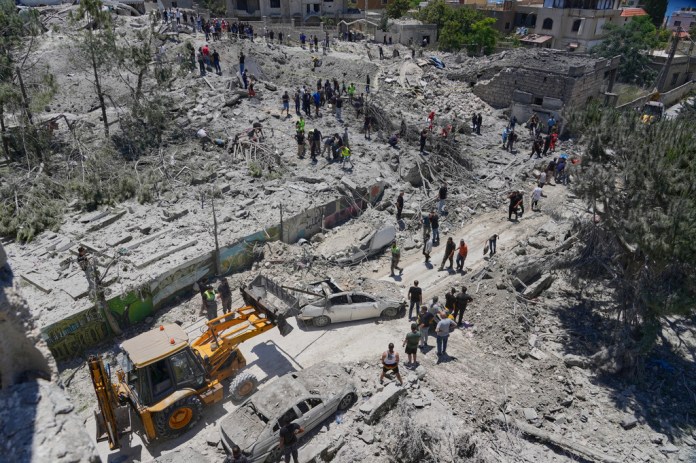


Talks between the U.S. and Iran were called off on Friday after intense fighting between Israel and Hezbollah in southern Lebanon, three officials said.
Coverage spectrum
Read at your length
Talks between the U.S. and Iran were called off on Friday after intense fighting between Israel and Hezbollah in southern Lebanon, three officials said.
Although a ceasefire has been in place since Friday afternoon, escalating hostilities threaten the agreement between Washington and Tehran as Israel shows no intention of withdrawing from southern Lebanon. Fighting between Israel and Hezbollah continued unabated in southern Lebanon, casting fresh uncertainty over planned talks between the US and Iran to permanently end the war in the Middle East and curb Tehran’s nuclear program. US and Iranian diplomats are reportedly heading to Switzerland for peace talks.
An initial round of negotiations involving US Vice President JD Vance was delayed as fighting continued in Lebanon. Talks between the U.S. and Iran were called off on Friday after intense fighting between Israel and Hezbollah in southern Lebanon, three officials said.
Le Monde English reported the story as "Lebanon ceasefire between Israel and Hezbollah remains fragile under US-Iran pressure." CBS News reported the story as "Uncertainty surrounds U.S.-Iran deal as Israel strikes Lebanon." Washington Examiner reported the story as "Israel and Hezbollah continue fighting after ceasefire in Lebanon."
Coverage is split across the political spectrum: 6 left-leaning outlets, 5 center outlets, 6 right-leaning outlets. L1FE compares the framing across these sources rather than amplifying any single outlet's interpretation.
17 sources have covered this story, including Washington Examiner, CBS News, Le Monde English and Bloomberg and 13 other outlets. The earliest reporting in the cluster landed about 5 hours ago.
Source accounts have not fully aligned on every figure tied to this story (different reports cite 19, 47); the published L1FE summary holds those specifics open until more sources converge.
How each side is reporting it
How the left is reporting it
Emphasizes · omits ▾
- Institutional accountability, affected communities, structural causes, expert consensus.
- Procedural concerns and dissenting expert voices raised on the right.
Uncertainty surrounds U.S.-Iran deal as Israel strikes Lebanon
Tehran declares Strait of Hormuz is closed after Trump deal due to ‘ceasefire violations’
Trump news at a glance: Israel-Hezbollah clashes ground Vance trip; Qatar jet is new Air Force One
Lebanon Cease-Fire Bolsters U.S.-Iran Truce, After a Shaky Start


How the wires + center are reporting it
Emphasizes · omits ▾
- On-the-record fact pattern, primary documents, dollar figures, named officials.
- Frame-setting context that explicitly partisan desks foreground.


How the right is reporting it
Emphasizes · omits ▾
- Costs, unintended consequences, procedural concerns, elite-mismanagement narrative.
- Affected-community testimony and structural-cause analysis.


Where sources agree
No shared facts cached yet.
Where they diverge
No contradictions cached yet.
Claim ledger
[01] VerifiedCore event reported by 17 independent outlets across the spectrum.
[02] CorroboratedKey facts corroborated by mainstream + wire desks.
Where they stand

Framings — how each side is covering it
Mainstream Liberal
6 outlets


Mainstream Conservative
6 outlets


Center / Wire
5 outlets
